
 Image 1 of 1
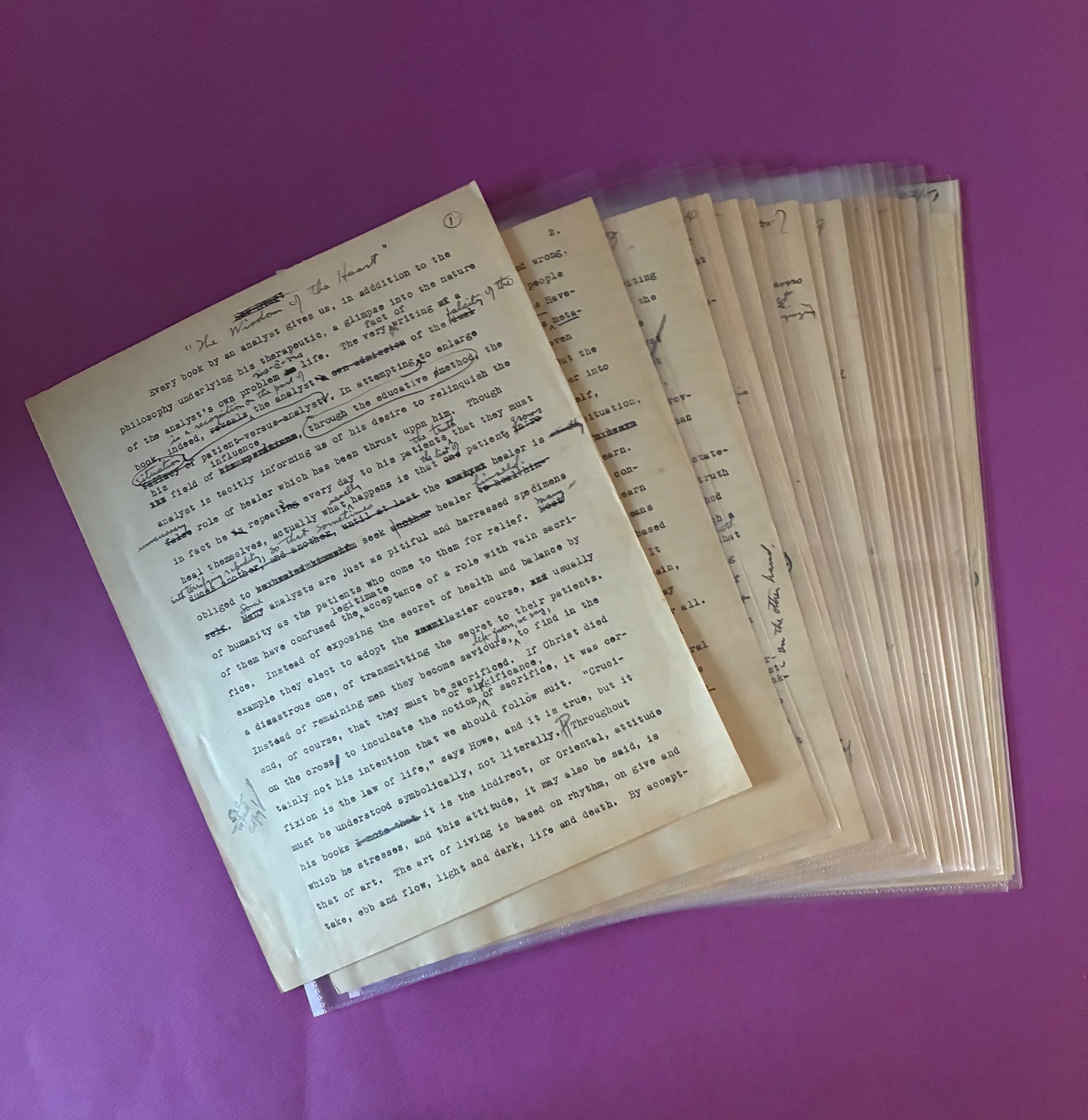
of some 5000 words for "The Wisdom Of The Heart" (circa 1939). 18 pages typed on the rectos only with Miller's extensive holograph emendations throughout. The text, which would become the title essay for Miller's book of the same name, was published by New Directions in 1941 and explicated the books of E. Graham Howe, a British psychiatrist, providing the springboard to Miller's leap into esoteric depths of philosophy, occultism and the limitations of human understanding. Put simply, Miller's words constitute nothing less than a profound search for the meaning of life itself.
Collation of the typescript with the published version reveals literally hundreds of words of entire phrase substitutions, deletions, and interlinear additions. In one case Miller has crossed out almost an entire page that he finds not expressive enough of his thought-provoking meanderings.
Here are a few defining excerpts: "The art of living is based on rhythm, on give and take, ebb and flow, light and dark, life and death."
"Science carefully measures the seen, but it despises the unseen."
"To become more aware is to sleep more soundly, to cease twitching and tossing. It is only then we get beyond dream, beyond phantasy -- only then that the real conversion takes place and we awake reborn."
The typescript is accompanied by an ALS which Miller sent to his friend and fellow-expatriate, David Edgar. "Have no idea where it will be printed, if ever, but glad I got it done."
A remarkable documentation that illuminates Henry Miller's transition from bawdy Paris bohemianism back to the stable America he had resoundingly rejected. Fine.
of some 5000 words for "The Wisdom Of The Heart" (circa 1939). 18 pages typed on the rectos only with Miller's extensive holograph emendations throughout. The text, which would become the title essay for Miller's book of the same name, was published by New Directions in 1941 and explicated the books of E. Graham Howe, a British psychiatrist, providing the springboard to Miller's leap into esoteric depths of philosophy, occultism and the limitations of human understanding. Put simply, Miller's words constitute nothing less than a profound search for the meaning of life itself.
Collation of the typescript with the published version reveals literally hundreds of words of entire phrase substitutions, deletions, and interlinear additions. In one case Miller has crossed out almost an entire page that he finds not expressive enough of his thought-provoking meanderings.
Here are a few defining excerpts: "The art of living is based on rhythm, on give and take, ebb and flow, light and dark, life and death."
"Science carefully measures the seen, but it despises the unseen."
"To become more aware is to sleep more soundly, to cease twitching and tossing. It is only then we get beyond dream, beyond phantasy -- only then that the real conversion takes place and we awake reborn."
The typescript is accompanied by an ALS which Miller sent to his friend and fellow-expatriate, David Edgar. "Have no idea where it will be printed, if ever, but glad I got it done."
A remarkable documentation that illuminates Henry Miller's transition from bawdy Paris bohemianism back to the stable America he had resoundingly rejected. Fine.